This page describes marine creatures that are considered venomous. It does not include creatures that are poisonous. A creature is considered poisonous if it contains toxins stored in special tissues or organs that cause harm when eaten. A creature is considered venomous if there are specialized mechanisms to physically deliver the toxins through bites, spines and stings. For example, a pufferfish is poisonous when eaten but is not venomous in that it does not bite or sting in order to deliver the toxins present in certain organs in its body. By contrast, a stonefish is venomous as it has pressure-sensitive glands and spines that help to deliver its toxins when stepped on.
Marine creatures within the reef ecosystem have evolved different types of predatory and defensive mechanisms in order to survive such as venomous stings, spines and bites. Many of these are among some of the world's most venomous creatures. In Animal Planet's 'Most Extreme: Venom' program, marine creatures made up half the list of the top ten most venomous creatures. These include the box jellyfish (chironex fleckeri and irukandji), stonefish, blue-ringed octopus, cone shells and sea snakes. All of these, other than the box jellyfish, can be found in Malaysian waters including those around Redang.
Fortunately for us, these creatures are not naturally aggressive toward humans and do not go out of their way to attack us. It is only when our presence and behaviour threatens and provokes them that they act in self-defense. Most unpleasant encounters and injuries are caused by people accidentally touching them, stepping on them, trespassing onto their nesting sites, harassing them or handling them roughly. Avoiding physical contact is one of the best precautions we can take.
In the sections below, this symbol  is used to indicate marine creatures which are among the most venomous creatures on earth.
Best precaution: zero contact
- Avoid touching or handling reef creatures. Just observe them.
- Shuffle your feet when walking in shallow water so you don't step on creatures hiding on the seabed.
- Wear clothing to avoid getting stung or scratched. Stinging coral or jellyfish only sting exposed areas of your body. Clothing will also help minimize cuts when you bump into hard coral.
- Look carefully where you are going and where you place your hands. Some jellyfish may be hard to see and that 'rock' you place your hand on or bump into might be some reef creature in disguise.
- Maintain good buoyancy control when diving. Wear a life-jacket when snorkelling to stay buoyant and avoid stepping on corals or rocks.

Sharp teeth of the giant moray eel.

Powerful jaws of the triggerfish.
When threatened, the first line of defense for many reef animals is to hide: "if you can't be seen, you can't be eaten". Some will employ deception, mimicry and camouflage to disguise themselves. Others will hide in holes or crevices. Those that can't hide may distract predators with inks, lights or ejected parts while they make a quick getaway. Others show off bold, bright colours to suggest they are poisonous and to warn predators to keep away. With predators and prey living on the same reef, there is an astounding array of defensive mechanisms and strategies employed by reef creatures, some of which are designed to inflict pain and injury to predators, including humans. Here are some of them:
- Slow-moving creatures like urchins, sea stars and cone shells use chemicals or poisons in combination with darts, spines and needles to protect themselves.
- Stonefish and scorpionfish carry lethal venom on dorsal spines, rays carry venom in their stings, while boxfish, pufferfish, soapfish and toadfish secrete skin poisons.
- Jellyfish, corals, anemones and hydroids have stinging cells which can fire a mass of tiny harpoons (called nematocysts) containing venom to stun and kill their prey.
- Some species of octopus have venom in their saliva. For example, the bite from the tiny blue ringed octopus can be lethal to humans.
- Some innocent-looking reef fishes are equipped with self-defense mechanisms. Squirrelfish and angelfishes have spines on their gill-covers which are venomous in some species of squirrelfish. Surgeonfish have a retractable blade or scalpel at the base of the tail which it uses to slash would-be attackers.
- Some sea cucumbers eject white cuiverian tubules when irritated. These contain toxins that can cause blindness when it comes into contact with the eye - so make sure you wash your hands after handling them. Others are able to cast off parts of their gut as sacrificial bait or emit sticky filaments to entangle would-be predators, including humans. These body parts are regenerated.
- Barracudas, sharks, eels and triggerfishes have powerful jaws for biting while the mantis shrimp uses its deadly claws to spear or smash their victims. Electric rays and electric eels can deliver high-voltage electric shocks to stun its prey.
Blue-ringed octopus

Blue-ringed octopus.
This golf ball-sized octopus is small, about 7 cm long, shy and hides in coral crevices or under rocks. It may look cute, harmless and attractive but is amongst the most dangerous creatures on the planet. Its venomous bite has claimed a number of human lives as its saliva contains TTX (tetrodotoxin) produced by a bacteria, one of the most potent neurotoxins for which there is no known antidote. TTX is considered to be a hundred times more powerful than potassium cyanide and is also found in certain organs in the pufferfish, porcupinefish, sunfish and a few other animals. The blue rings on its body are only clearly visible and pulsate when the octopus is agitated and about to bite. The bite is slight, reported to be accompanied by little or no pain, but will lead to muscular paralysis and respiratory failure that can lead to death if not treated early (though there have only been 3 documented human fatalities so far). For more information, read Dr. Roy Caldwell's article on blue-ringed octopuses.
Sea snakes

Banded sea krait.
Sea snakes are reptiles, have scales and flattened, paddle-like tails with heads that resemble land snakes whereas eels are fishes, have a fish-like face and mouth as well as one long continous dorsal fin. All sea snakes are highly venomous and should not be handled even though they are shy, gentle and do not normally pose a threat unless provoked. When they do bite, venom is injected only in less than a third of all bites and antidotes are available for treatment, which has greatly reduced the number of fatalities arising from seasnake envenomations. Most victims were fishermen trying to remove seasnakes from their nets or catch.
Sea snakes may approach divers or snorkellers out of curiosity. The best defense is to stay calm and not lash out at the snake and it will soon continue on its way. As with other reptiles, they breathe air and have to periodically return to the surface. They are usually found in depths between 5 to 10 metres hunting for food on the seabed or coral reef.
Scorpionfish and Stonefish

Scorpionfish.

Stonefish.
The family of fishes known as Scorpaenidae include lionfish, scorpionfish and stonefish. They have venomous spines on their dorsal fins as a defense against rays and sharks. Some species also carry these spines on their pectoral and anal fins. All of them, except for the brightly coloured lionfishes, are well camouflaged, blending with their surroundings and remaining stationary. All are carnivorous and eat mainly smaller fishes. Hunting primarily at night, they sit and wait until an unwary prey comes near, then they extend their jaws and suck in the prey at lightning speed. Only the lionfish moves in search of prey. The stationary scorpionfishes and stonefish are usually given away only by their large pectoral fins and slightly curled up resting position on the sea bed, corals or rocks. They are typically grayish-brown and grow up to about 15 inches in length.
The stonefish, the most venomous fish in the world, looks like encrusted rock or dead coral. Most human victims injure themselves when they accidentally step on it or place their hands on it. 13 hard spines on its back, sharp enough to puncture rubber soled shoes, carry neurotoxic venom into the wound when the spines are pressed, causing excruciating pain, temporary paralysis and shock, and in rare cases, even death (only 3 fatalities from stonefish envenomation has ever been recorded).
The best way to avoid stepping on stonefishes and scorpionfishes (and any other bottom dwellers like rays) is to shuffle one's feet when wading in shallow waters. This way, any accidental contact is on the side of the fish which avoids triggering the venomous spines on their back. Stonefish spines have been known to pierce the soles of shoes, so even if you're wearing shoes for protection, tread lightly or shuffle your feet. Also, be very careful where you place your hands - the 'rock' you hold on to might be alive!
Crown of thorns

Crown of thorns starfish.
The Crown of Thorns starfish Acanthaster Planci is the only venomous starfish. It can grow up to a metre in diameter and can have as many as 21 arms. It is covered with sharp spines all over its body except on its underside. Spines can grow up to 6cm in length and can easily penetrate a wetsuit. On contact, the spines release a variety of toxins which although not fatal, are painful, causes redness and local swelling. In some cases, stings may also cause nausea and vomiting. Upon contact, spines may break off and remain embedded.
This starfish eats corals by releasing stomach acids onto the coral polyps, liquifying them and then consuming them. They have voracious appetites and can cause widespread damage to coral reefs if their numbers become too large. When that happens, clean-ups are sometimes organized (although such cleanups are widely debated amongst conservationists) where divers collect these starfish and then dispose of them on land.
Urchins

Fire urchin.
Urchins, starfish and sea cucumbers all belong to the class of animals known as Echinoderms. While many echinoderms are poisonous, only a few species can cause venomous injuries to humans. Venomous urchins like fire urchins (Asthenosoma species) and long-spined urchins (Diadema species) deliver their venom through their spines while flower urchins (Toxopneustes pileolus) deliver venom through jaw-like organs called pedicellaria supported on stalks and surrounded by non-venomous spines. Those with pedicellaria are among the most venomous urchins and the pedicellaria continue to release the venom even when detached from the urchin. Needless to say, contact with urchin spines and pedicellaria are acutely painful. The spines usually break off and become embedded in the skin. Some may be absorbed while others extruded through the skin.
Cone shells

Cone shell in a tide pool with the proboscis extended.
Cone shells are highly sought after by shell collectors due to their attractive and intricate markings. They can be found during low tide in tide pools or in shallow water, particularly at night when they come out to feed, which make them easily accessible to non-swimmers and beach combers.
Behind this attractive facade is a highly venomous harpoon which is used to paralyze prey, typically fish, molluscs or worms, before drawing it back to their mouths. The venom is contained in the tongue-like proboscis (radula) equipped with harpoon-shaped teeth. The harpoon can be fired numerous times if needed and with such force that it can pierce wetsuits and clothing. Many human victims get stung when they carry them in pockets or in mesh bags close to the body. The venom contains neurotoxins which cause weakness, loss of coordination, and in serious cases, respiratory failure and even death. So far, there have been about 30 recorded fatalities from cone shell stings, most of them from the Conus Geographus species. As the venom has analgesic (painkiller) properties, human victims suffer little pain, if any. For more information, visit the Cone Shells and Conotoxins site.
Stingrays

Blue spotted stingray partially hidden in the sand.

Twin barbs on the tail of a stingray.
Stingrays are shy and frequently hide in shallow waters under rocks or buried under the sand with only their eyes slightly exposed. The front half of the tail may have up to 7 barbs or spines located on the top side which the ray can use to inflict a painful, venomous sting to any aggressor by whipping its tail upwards in an arc, much like the way a scorpion stings. The barb, which can be up to 25cm long, has razor-sharp serrations and is sometimes hidden beneath a sheath and exposed only when striking. The barb may break off after a strike and become lodged in the victim. Rays can grow new barbs and do so whether they use it or not. Not all rays have stings. Devil rays, manta rays, butterfly rays and some that are sometimes called 'rays' (like guitarfishes, electric rays and certain skates) do not have stings.
Rays are gentle creatures which is why they are commonly found in touch-pools at public marine aquariums, though these usually have had their barbs removed. In the wild, they forage for their food by flapping and uncovering prey hiding in the sandy bottom and never use their sting when hunting. Their barbs are used only for defense especially against their predators (mainly sharks). Most human victims are stung around the ankles or feet when they accidentally step on the ray. Fishermen have been known to be stung while sorting out their catch, which includes sting rays, on the boat deck.
Fatalities involving ray stings are rare but in what is probably the most publicised incident involving a stingray, well-known Australian conservationist Steve Irwin, better known as the Crocodile Hunter, died after being stung in the chest by a large bull ray that was startled. As with the stonefish, the best way to avoid stepping on rays is to shuffle one's feet when wading in shallow water. Divers should avoid cornering rays and not swim close to and directly on top of the ray where they may be perceived as a threat.
Jellyfish
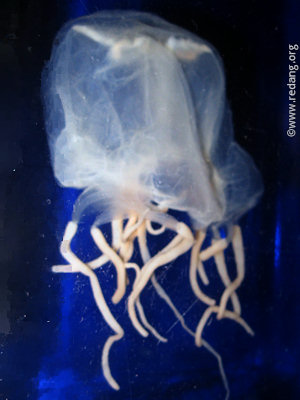
Preserved specimen of box jellyfish in Sydney Aquarium.
Jellyfish are not fishes, but are closely related to corals, hydroids and anemones (known collectively as cnidarians which literally means 'stinging creatures'). All possess stinging cells which are used to capture prey. Jellyfish are related to coral polyps (see What are corals?) and are the free-floating medusa-form of cnidarians, while anemone and coral polyps are the fixed polypoid form.
Jellyfish are composed mainly of water and absorb oxygen directly from the surrounding water. Their tentacles range from 1 cm to 36 metres in length, and contain hundreds of thousands of nematocysts. The bell does not contain stinging cells. Nematocysts can still sting even when the tentacles are severed from the jellyfish so beware of touching jellyfish washed up on beaches or broken tentacles floating in the water.
Most varieties of jellyfish stings are harmless to humans (other than causing painful stings and welts). Of about 2000 known species, only about 70 can seriously harm humans, including the box jelly Chironex, also known as the Sea Wasp, and the tiny Irukandji jellyfish. Some species of jellyfish don't even sting at all, like those found in Jellyfish Lake, Palau and Kabakan island, east Kalimantan, Indonesia.
The box jelly Chironex fleckeri is the world's most venomous jellyfish and possibly the
world's most venomous creature, causing about 70 fatalities just in Australia, and between 20-40
deaths annually in the Philippines. It is found mainly in the northern coastal waters of Australia
and in some parts of the Indo-Pacific. It prefers coastal beaches and sheltered inlets and is rarely
encountered on coral reefs. Despite its fearsome reputation, green turtles have been observed eating
Chironex fleckeri without any problems.
Covering up exposed skin by wearing a full-length wetsuit, lycra swimwear, clothes or even stockings is the best protection against jellyfish as the stinging cells are triggered by the presence of chemicals on the skin. For this reason, some Australian surf lifeguards wear nylon panty hose on their arms and legs. Lotions like Safesea from Nidaria have also been proven to be effective in preventing these stinging cells from firing.
Hydroids and stinging corals

Stinging hydroids.
Fire corals (millepora) and hydroids are hydrozoans, closely related to jellyfish, anemones and other corals. All possess stinging cells called nematocysts, which release thousands of tiny spring-loaded venomous darts upon contact with the skin, causing a painful rash and burning sensation. Despite the pain, stings from fire coral and stinging hydroids are not dangerous unless accompanied by allergic reaction.
Fire coral looks like dead branching hard coral with no visible tissue, mucus or polyps. All species have a characteristic whitish or yellowish tip on each branch and also have a soft, hairy, rounded or fine texture, unlike other hard corals which have a rougher appearance. Most common species of fire coral are typically brown or mustard yellow in colour.
Lace coral looks like hard coral fans with beautiful branches usually adorning ceilings of caves and over-hangs.
Stinging hydroids are commonly found attached to rocks, wrecks, shells, sponges and corals and look like ferns with a central stalk and many side branches. Some crabs, like hermit crabs, and other molluscs may carry hydroids on their shells as a form of protection.
Most cases of stings are caused by accidentally brushing against these stinging corals. As with jellyfish, covering up exposed skin will prevent stings.
More information...
The following are some general tips gleaned from medical websites on how to treat victims of stings and wounds caused by the more common venomous marine creatures. It is not an exhaustive list and is provided more as an emergency first-aid guide. Please refer to the links provided opposite for more detailed information on venomous marine creatures and first-aid treatment.
Jellyfish, fire coral and hydroid stings
The treatment of coelenterate stings (hydroids, jellyfish, fire coral) typically involve deactivation of the stinging cells (nematocysts), followed by removal of any tentacles and management of the injected venom:
- Calm the victim and remove victim from the water to prevent any further contact with the source.
- Do not rub with sand or a towel, and do not pour fresh water which will trigger unfired stinging cells.
- Apply house vinegar (5% vinegar solution) to deactivate the stinging cells, until the stinging stops. DO NOT APPLY ALCOHOL. Vinegar should work with all jellyfish stings except for the Portugese Man of War (Bluebottle) and Irukandji jellyfish. Note that vinegar does not decrease pain nor does it decrease the effects of the venom - it only prevents the injection of more venom by disabling undischarged nematocysts from firing.
- Remove tentacles with a gloved hand or tweezers to keep from getting stung, then rinse with more vinegar or salt water.
- Apply a paste or solution of meat tenderizer, if you have it, to neutralize the venom.
- Use analgesics to relieve pain, or if these don't work, try icepacks or cold vinegar.
- Dry the skin and apply hydrocortisone ointment and take a diphenhydramine preparation (like Benadryl) for mild allergic reactions.
Note that in all of the above cases, watch out for any life-threatening reactions like spasms, shock and breathing difficulty. If these are present, seek emergency medical attention immediately.
Stonefish, ray and urchin wounds
The treatment for wounds from venomous spines typically involve slowing venom absorption and breaking down the venom:
- If possible, elevate the affected area and apply a pressure bandage to slow the absorption of venom in the wound. Do not apply tourniquets as this may cause more damage than it will prevent.
- Immerse the wound in hot water, as hot as you can tolerate, for 30 to 90 minutes to destroy the proteins present in many marine toxins, and to reduce the pain and swelling.
- Control the pain using local anesthetics to prevent shock, since the pain from marine stings can be excruciating.
- Clean the wound with an antiseptic solution and remove spines that are accessible (soaking in vinegar can also be used to dissolve superficial spines). Spines that are deeply embedded may need surgical removal.
- Seek appropriate medical attention for all stings as anti-tetanus medication and antibiotics may need to be administered for infection control, as are antivenins and life support for severe stings.